USD
USD
Why turn to Paycnc for help when machines encounter problems?
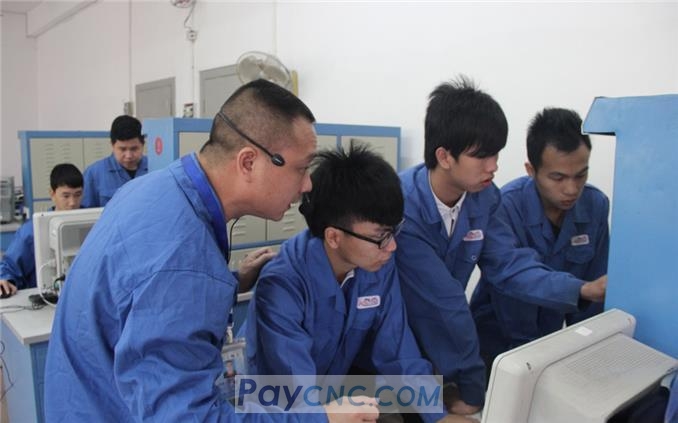
Because for many factories, when a CNC machine goes down, the priority is not finding the person who knows the most—it’s finding someone who can help get the machine running again as quickly as possible.
If factories immediately turn to PayCNC when they have a machine problem, it usually means PayCNC has built several strong advantages:
1. Fast response
Every minute of downtime costs money. Instead of spending hours searching manuals or troubleshooting alarm codes themselves, operators can simply send PayCNC the alarm, photos, or videos and get help quickly.
2. Practical, real-world troubleshooting
CNC problems are often more complicated than the alarm code suggests.
For example:
* Fanuc alarm → servo, encoder, PMC, parameter, power supply, or mechanical problem
* Spindle won’t run → drive, PLC, interlock, contactor, parameter, or motor problem
* ATC failure → tool changer position, sensors, air pressure, PMC signals, etc.
* Axis won’t return to zero → home switch, encoder, parameters, servo, or mechanical issue
Experienced troubleshooting means following the symptoms and tracing the entire fault chain—not simply explaining what an alarm code means.
3. Factories don’t encounter every problem often enough to remember the solution
A factory may have dozens or hundreds of machines, but a particular fault might happen only once every few years.
So the technician’s thought process becomes:
“I’ve never seen this problem before. Let’s send it to PayCNC.”
4. Trust is built through repeated successful cases
If PayCNC has helped a factory several times:
Machine problem → Contact PayCNC → Get a solution
eventually the customer doesn’t even bother searching Google first. PayCNC becomes their first call.
5. PayCNC effectively becomes a remote CNC engineering department
For a small or medium-sized factory, hiring an engineer who understands Fanuc, Siemens, Mitsubishi, Okuma, GSK, Fagor, servo drives, spindle drives, PLCs, CNC parameters, and mechanical troubleshooting can be expensive.
PayCNC can effectively provide an experienced CNC engineer on demand, without the factory having to employ one full-time.
The real reason
I don’t think the biggest advantage is simply that “PayCNC knows a lot.”
The real advantage is:
When a customer’s machine stops, they trust PayCNC to help them understand the problem and find a practical solution.
That trust is extremely valuable.
And over time, every troubleshooting case becomes part of a larger knowledge base:
Problem → Diagnosis → Solution → Case history
The more cases PayCNC handles, the faster and more accurately it can diagnose the next similar problem.
That’s how a CNC technical-support company can gradually build a very strong technical and customer-service barrier that competitors are difficult to replicate.